Community Pharmacy Is Under Severe Strain — And Patients Will Feel the Impact
Jaydev Varsani – Clinical Pharmacist
At Murrays Chemist and Bramley Pharmacy, we remain committed to delivering safe, accessible, high-quality care.
But we also believe in being transparent.
Community pharmacy in England is facing one of the most financially challenging periods in its history — and patients are beginning to feel the consequences.
This is not speculation. It is supported by data and market behaviour.
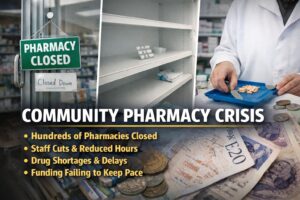
Pharmacy Closures Are Accelerating
The community pharmacy network is shrinking at a concerning pace.
Recent figures show:
-
Over 200 pharmacies closed in England in 2024 alone.
-
Nearly 700 pharmacies have closed since 2022.
-
Closures have averaged five to eight per week over the past year.
-
England now has one of the lowest numbers of community pharmacies seen in two decades.
These closures disproportionately affect areas of deprivation, where healthcare access is already under pressure.
When a pharmacy closes, patients lose more than a shop. They lose:
-
Local access to prescriptions
-
Walk-in clinical advice
-
Blood pressure checks
-
Vaccination services
-
A key NHS touchpoint
Large Chains Are Exiting the Sector
This is not just an issue for small independents.
LloydsPharmacy, once the second-largest pharmacy chain in the UK, exited the traditional high street market after selling all branches and the operating company entering liquidation in 2023.
Morrisons, which operated around 115 in-store pharmacies, has initiated the sale of dozens of its branches after determining they were no longer financially viable under the current funding model.
When national operators with scale and buying power conclude the model does not work, that should prompt serious reflection.
Core NHS Funding Has Not Kept Pace
Over the past decade:
-
Workload has increased
-
Clinical responsibility has expanded
-
Regulatory burden has intensified
-
Staffing costs have risen significantly
-
Energy and operational costs have surged
However, the global sum allocated to community pharmacy has remained effectively flat in real terms.
Pharmacies are absorbing inflation without corresponding uplift in funding.
This is not sustainable economics.
The Supply Chain and Pricing Problem
Patients often ask why prescriptions are delayed.
Here is the reality.
When medicines are reimbursed at low Drug Tariff prices, manufacturers may prioritise selling those products in markets where margins are stronger. That reduces UK supply.
When stock becomes scarce:
-
Pharmacies often have to purchase medicines at inflated prices.
-
NHS reimbursement may not reflect what was actually paid.
-
Price concessions are typically announced retrospectively.
-
Reimbursement can later be adjusted or clawed back.
This means pharmacies are frequently expected to carry significant financial risk just to supply essential medication.
Repeatedly dispensing at a loss is not viable for any business — including a healthcare provider.
What Patients May Notice
Without meaningful reform, patients will increasingly see:
-
Reduced opening hours
-
Longer prescription waiting times
-
Free delivery services being reviewed
-
Free dosette boxes being reconsidered
-
Fewer pharmacies in local communities
These changes are not driven by lack of commitment.
They are driven by basic financial sustainability.
Praise Without Investment
Community pharmacy is regularly praised for:
-
Reducing GP workload
-
Delivering vaccinations
-
Managing minor illnesses
-
Providing contraception services
-
Supporting long-term condition management
Yet recognition has not been matched by structural funding reform.
Community Pharmacy England is currently negotiating future arrangements. Contractors across the sector remain cautious. After years of real-terms contraction, confidence must now be rebuilt through tangible support.
Why This Matters
Community pharmacy is one of the most accessible healthcare settings in England.
If the network weakens further:
-
GP surgeries will see increased pressure
-
Hospital attendances will rise
-
Preventative care will reduce
-
Health inequalities will widen
This is not a pharmacy issue alone. It is a healthcare system issue.
Our Commitment
At Murrays Chemist and Bramley Pharmacy, we continue to:
-
Invest in clinical services
-
Maintain patient safety as our absolute priority
-
Communicate transparently
-
Support our local communities
But the pressures facing the sector are real.
Sustainable funding, fair reimbursement and supply chain reform are not optional luxuries. They are essential if community pharmacy is to remain a cornerstone of primary care.